Behavioral health care, including mental health care, has always been essential to whole-person health. In recent years, and especially since the onset of the COVID-19 pandemic, the need to better understand access, use, and care has become even more important.
This updated article (originally published in 2022) explores what the Colorado All Payer Claims Database (CO APCD) can tell us about care for people with mental health needs.
More People Accessing Services
Behavioral health care claims, which include treatments and services for mental health conditions and substance use disorders, have consistently grown according to claims data in the CO APCD Insights Dashboard. From 2019 to 2025 the number of behavioral health care claims more than doubled from 2.9 million to 6.3 million. The number of individuals seeking services also saw a similar spike, growing from about 450,000 in 2019 to 720,000 in 2025.

There are several possible reasons behind this steady increase in volume, such as more access to behavioral health providers via telehealth, better insurance coverage for behavioral health, and a reduction in the stigma associated with seeking care for behavioral health services.
Access via Telehealth
Telehealth services for primary care soared during the pandemic, and CIVHC’s Telehealth Services Analysis shows that the number of people receiving primary care through telehealth has steadily declined since 2020. However, the number of people receiving behavioral health services has remained relatively steady after the pandemic, demonstrating a continued demand for these services.

The analysis further shows that mental health has remained the top diagnosis type across the state and across demographics receiving care through telehealth. Among the mental health conditions diagnosed, the top diagnosis was generalized anxiety disorders, followed by depressive disorders and post-traumatic stress disorder.
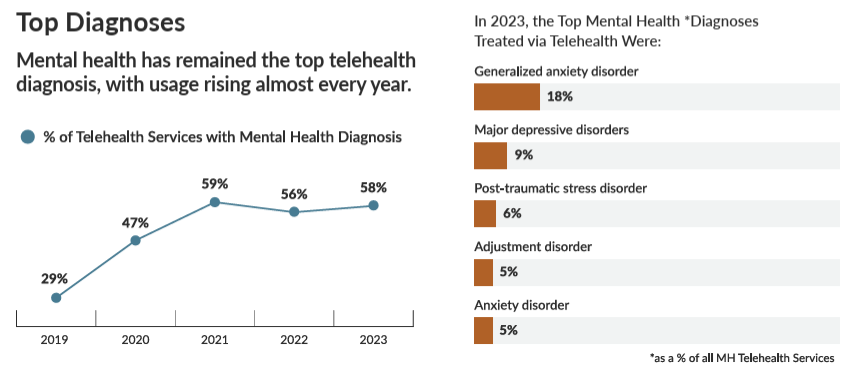
Mental health diagnoses, in fact, represent the top diagnosis type across demographic groups receiving telehealth services. For each age group, sex, and race/ethnicity category, mental health remained the top diagnosis among those using telehealth. This continues to hold true across further breakouts by payer type, illustrating a consistent, deep need for access to mental health services across Colorado.

Prevalence of Mental Health Conditions
CIVHC’s Chronic Conditions Analysis sheds further light on the prevalence of mental health conditions throughout our state. The analysis examines the cost and prevalence of 30 chronic conditions, including depression, bipolar, or other depressive mood disorders. These conditions proved to be both among the most prevalent, and the most costly, chronic conditions in Colorado.
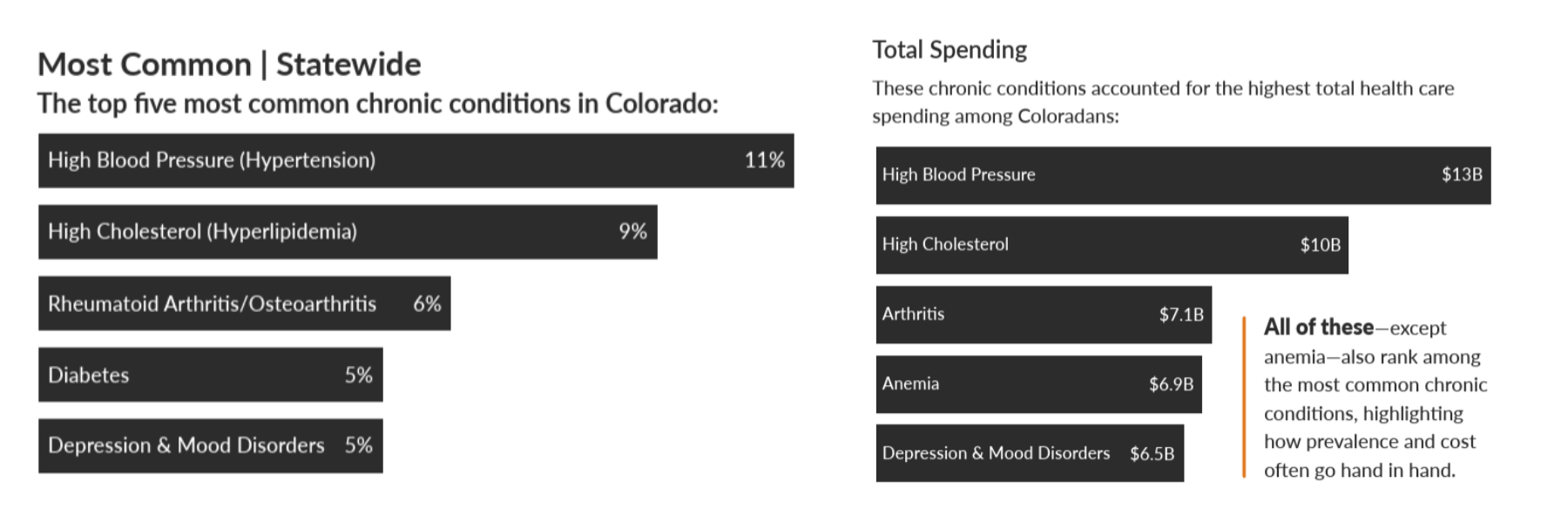
The analysis offers further insight into those more impacted by mental health conditions, particularly by sex and age demographic. Using the data, we see that depression and mood disorders are among the top two most common conditions in the 0-17 and 18-34 age groups, showing a higher prevalence among younger Coloradans.

Women also disproportionately experience depression and mood disorder diagnoses, with 5.9 percent of eligible females diagnosed with depression, bipolar, or other depressive mood disorders compared to three percent of males. For women 65+, that number rises to 12.1 percent.
Gaps in Access to Care
While there are many efforts to expand methods of access for mental health care in Colorado and improve care, Coloradans do not always have timely, comprehensive access to care. Due to these gaps, the Emergency Department (ED) continues to be a main source of support for many suffering mental health crises.
CIVHC’s analysis of ED Use for Mental Health and Self-Harm in Colorado found that over 25,000, or roughly two percent, of visits to the ED in 2021 were related to mental health or potential self-harm. Of those, eight percent resulted in hospital admission.
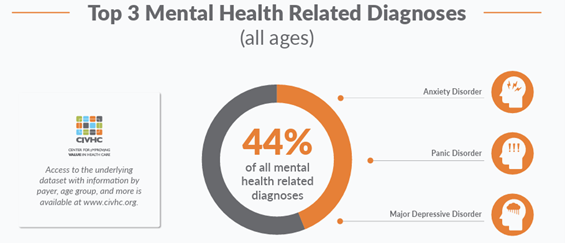
Anxiety and depressive disorders again proved to be the most prevalent among mental health diagnosis types, making up the top three most diagnosed conditions alongside panic disorders. Together, these top three diagnosis types accounted for 44 percent of all mental health-related diagnoses.
The analysis further shows a striking increase in ED utilization for mental health among children and youth under 18 in Colorado. From 2016 to 2021, the number of children who received a mental health or self-harm primary diagnosis more than doubled – from just over 2,000 diagnoses in 2016 to more than 5,100 in 2021, an increase of 158 percent.

Taken together, CO APCD data shows important progress in how Coloradans are accessing mental health care, including expanded use of telehealth and a continued growth in the number of people receiving behavioral health services. Hower, the data also shows sustained and significant demand across the state, particularly among younger Coloradans, women, and those living with anxiety, depression, and mood disorders. Using CO APCD data, communities and health leaders can identify opportunities to improve access to care, particularly among underserved populations, to provide more timely, accessible, and comprehensive mental health support across our state.