Public Data
Colorado County Profiles Enrollment Report
Explore the latest update to the Colorado County Profiles enrollment data, with commercial and Medicaid enrollment data from 2024 – 2026.
New Data Shows Shifts in Health Insurance Enrollment Across Colorado Counties
Enrollment data from April 2024 through April 2026 highlights notable changes across Colorado, especially when comparing urban and rural communities.
Health insurance coverage is an important part of understanding access to health care, but enrollment trends don’t always tell the same story across Colorado. While statewide numbers offer a broad picture of changing coverage, looking at urban and rural county data unveils trends at regional levels.
The Center for Improving Value in Health Care (CIVHC) released the Colorado County Profiles in early 2026, providing local communities with data to better understand health care trends and support informed decision-making. This new enrollment report now includes seven points in time* between April 2024 and April 2026, allowing users to explore changes in commercial and Medicaid enrollment over a two-year period.
Key Findings
Commercial Enrollment Declines Statewide, While Medicaid Trends Vary from April 2024 to April 2026.
Across Colorado, commercial health insurance enrollment declined 5% between April 2024 and April 2026. Both urban and rural counties experienced decreases, although the decline was greater in urban counties (-6%) than rural counties (-3%).
Commercial Enrollment Changes
County Commercial Enrollment
Colorado County Enrollment Percentage Changes from April 2024 to April 2026
Medicaid enrollment followed a different pattern, increasing 4% statewide over the same two-year period. However, this growth was not evenly distributed. Urban counties experienced a 5% increase in Medicaid enrollment, while rural counties saw a 2% decrease.
Medicaid Enrollment Changes
County Medicaid Enrollment
Colorado County Enrollment Percentage Changes from April 2024 to April 2026
Looking specifically at the most recent four-month reporting period (December 2025 through April 2026) the data shows some interesting shifts. Commercial and Medicaid enrollment each declined 1% statewide. However, rural commercial enrollment increased 6% during that period, while rural Medicaid enrollment decreased 6%. Urban Medicaid enrollment remained relatively stable.
These findings demonstrate how enrollment trends can differ depending on geography, coverage type, and the period being examined.
San Luis Valley and Southeastern Colorado See Notable Commercial Enrollment Declines
Some of the most substantial commercial enrollment decreases occurred in southern Colorado.
In the San Luis Valley, commercial enrollment declined 7% between April 2024 and April 2026. During that timeframe, several counties experienced particularly large changes, including Mineral County (-32%), Saguache County (-18%), and Conejos County (-14%).
Medicaid enrollment in the region remained comparatively stable, decreasing 1% over the two-year period.
Southeastern Colorado experienced similar declines in commercial coverage, with enrollment falling 8% between April 2024 and April 2026. In that period, Huerfano, Kiowa, Las Animas, and Cheyenne counties each experienced decreases of 10% or more.
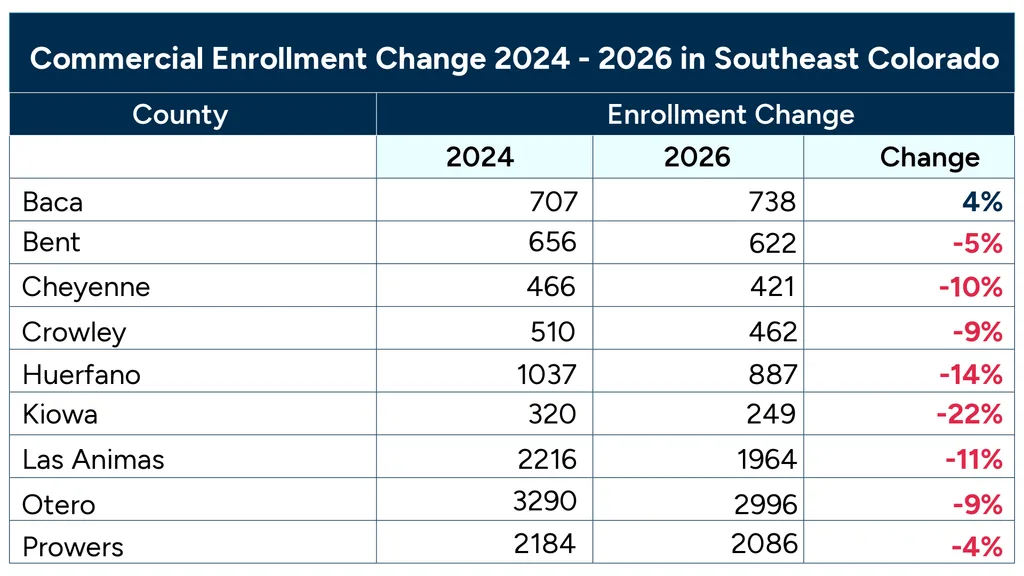
The region also experienced a 6% decline in commercial enrollment from April 2025 to April 2026, with Crowley, Kiowa, and Otero counties each recording decreases of at least 10%.
These regional findings demonstrate how statewide trends can take different shapes within individual communities.
Western Colorado Experiences Significant Enrollment Fluctuations
West Central Colorado offers another example of why examining multiple reporting periods is valuable.
Commercial enrollment in the region declined 10% between April 2025 and April 2026. In that time, Gunnison (-10%), Mesa (-11%), Montrose (-17%), and Ouray (-13%) all experienced enrollment drops of 10% or more.
Medicaid enrollment followed a different trajectory. Although the region experienced a relatively modest 3% decline between April 2024 and April 2026, enrollment fell 11% between December 2025 and April 2026 alone. Several counties experienced particularly substantial Medicaid enrollment declines during those four months, including San Miguel (-43%), Ouray (-34%), Gunnison (-32%), and Hinsdale (-18%).
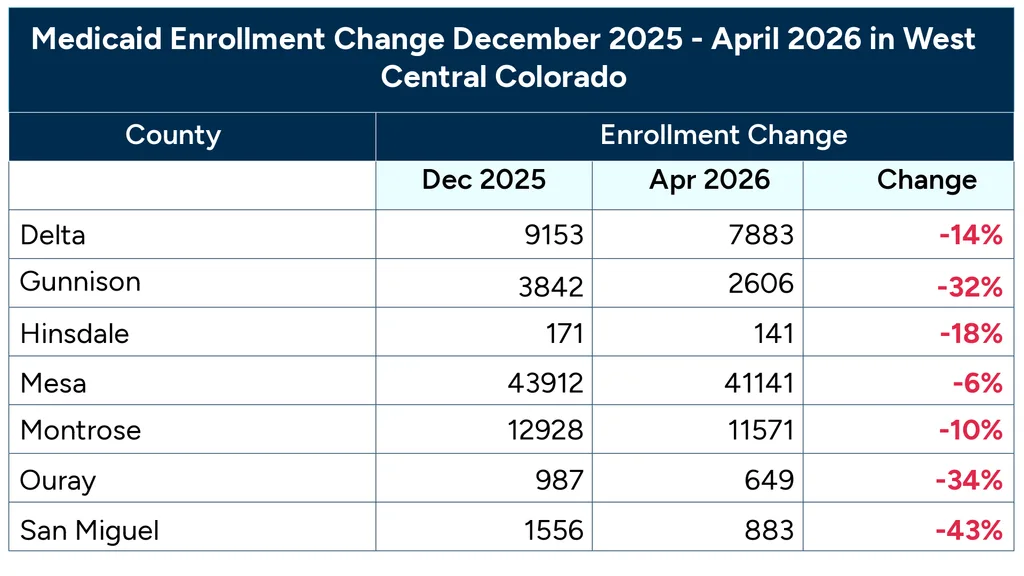
These fluctuations underscore the importance of examining enrollment at multiple points in time. A two-year comparison may reveal the overall direction of change, but more frequent data points provide additional context about when shifts occur.
Exploring Enrollment Changes Across Colorado
Changes in insurance enrollment can reflect many factors, including employment, eligibility, population changes, and movement between coverage types. While the County Profiles data does not establish the cause of these shifts, it provides a valuable starting point for understanding where changes are occurring and which communities may benefit from further analysis.
With expanded enrollment data, Colorado communities, health care organizations, researchers, policymakers, and others can explore local trends, compare counties, and identify questions for further investigation.
Explore the updated Colorado County Profiles to learn more about commercial and Medicaid enrollment trends in your community.
To see enrollment data for all 64 Colorado counties, download the full dataset
-
- *Enrollment changes were calculated by comparing county-level enrollment counts from April 2024 through April 2026, with snapshots in April, August, and December of each year. These comparisons do not account for other factors that may influence enrollment trends, such as population growth, demographic shifts, or migration.
-
- In counties with smaller populations, even modest changes in the number of enrolled individuals can result in substantial percentage fluctuations. These changes should be interpreted with caution and considered alongside actual enrollment counts, as large percentage shifts may not necessarily reflect significant changes in the number of people with coverage.